
Enough is Enough: The Fight for the Major Richard Star Act
Enough is Enough: The Fight for the Major Richard Star Act
America's toughest warriors are still fighting—but now it's against Congress.
The Cruel Mathematics of Sacrifice
Imagine surviving the unimaginable, only to discover that your own government views your wounds as a financial liability.
Marine Veteran Jamel Daniels wakes up each day, stepping out on one leg—the other lost to an IED blast in Iraq. Yet every month, the government claws back retirement pay he earned in blood.
Army Sergeant Emil Hirsch was medically retired after a roadside bomb in Iraq. He receives only a fraction of his earned benefits—simply because he didn't hit the arbitrary 20-year mark before the enemy hit him.
Major Richard Star, U.S. Army Reserve, fought stage-4 lung cancer from burn pits, spending his final months on oxygen lobbying to end the offset that slashed his retirement check until his death in 2021.
 Maj. Richard Star pictured with his daughters earlier in his Army career. (Star family's personal archive)
These warriors are among more than 53,000 Chapter 61 retirees forced into a cruel financial trade-off: every VA disability dollar earned through sacrifice comes directly out of their retirement pay.
This isn't just unfair—it's morally bankrupt.
The Wounded Veteran Tax: How Chapter 61 Retirees Get Cheated
Understanding the Offset
The current system forces combat-wounded veterans into an unconscionable choice:
- Option A: Take your VA disability compensation for service-connected injuries
- Option B: Keep your military retirement pay that you earned through service
You cannot have both. Every dollar received in VA disability compensation is deducted from military retirement pay, dollar for dollar.
This means that while a 20-year retiree with a 50%+ disability rating receives both their full retirement pay and VA disability compensation (thanks to Concurrent Retirement and Disability Pay - CRDP), a warrior wounded in combat before reaching 20 years gets penalized for their sacrifice.
The Wounded Veteran Tax
How the offset penalizes combat-wounded heroes
20-Year Retiree (50%+ Disabled)
Served 20 years, qualifies for CRDP with 50%+ disability rating
Chapter 61 Combat-Wounded
Medically retired due to combat injuries before 20 years
Loses $3,000/month due to the offset
The Injustice Explained
While 20-year retirees with 50%+ disability ratings receive both their full military retirement pay AND VA disability compensation (thanks to CRDP), combat-wounded veterans who were forced to retire early lose their retirement pay dollar-for-dollar against their disability benefits.
This means wounded warriors are financially penalized for their sacrifice.
The Major Richard Star Act
Would end this injustice and restore an average of ~$1,200/month to 53,000+ combat-wounded veterans
The Human Cost
Let's put faces to these numbers:
Captain Ryan Kules, U.S. Army: Was leading a military patrol in Iraq in 2005 when a roadside bomb threw him from his vehicle, severing his right arm and left leg. After being stabilized in Baghdad and airlifted to Germany for emergency surgery, he underwent more than two dozen surgeries at Walter Reed followed by 18 months of rehabilitation. Medically retired in May 2007, half his earned retirement was withheld, forcing him back to work immediately to feed a newborn daughter. He now serves as a director at the Wounded Warrior Project, working with veterans to overcome trauma through adventure-based learning.
 Retired Army Capt. Ryan Kules pictured in Iraq weeks before he was seriously injured by a bomb blast in 2005. (Ryan Kules)
Sergeant Adam Kisielewski, USMC: Was just 21 years old when a bomb rigged to a building door detonated in 2005 near Fallujah, Iraq. He and another Marine were searching the building room-to-room after a gunfight with insurgents when the blast occurred—the other Marine didn't survive. The severity of Kisielewski's wounds required amputation of his left arm at the shoulder and his right leg below the knee. Medically retired in October 2006 after more than a year of surgeries and rehabilitation, every VA dollar still cancels a dollar of retirement he earned in uniform. He now runs a nonprofit called NPLB Outdoors (No Person Left Behind), providing outdoor recreational adventures for veterans with disabilities.
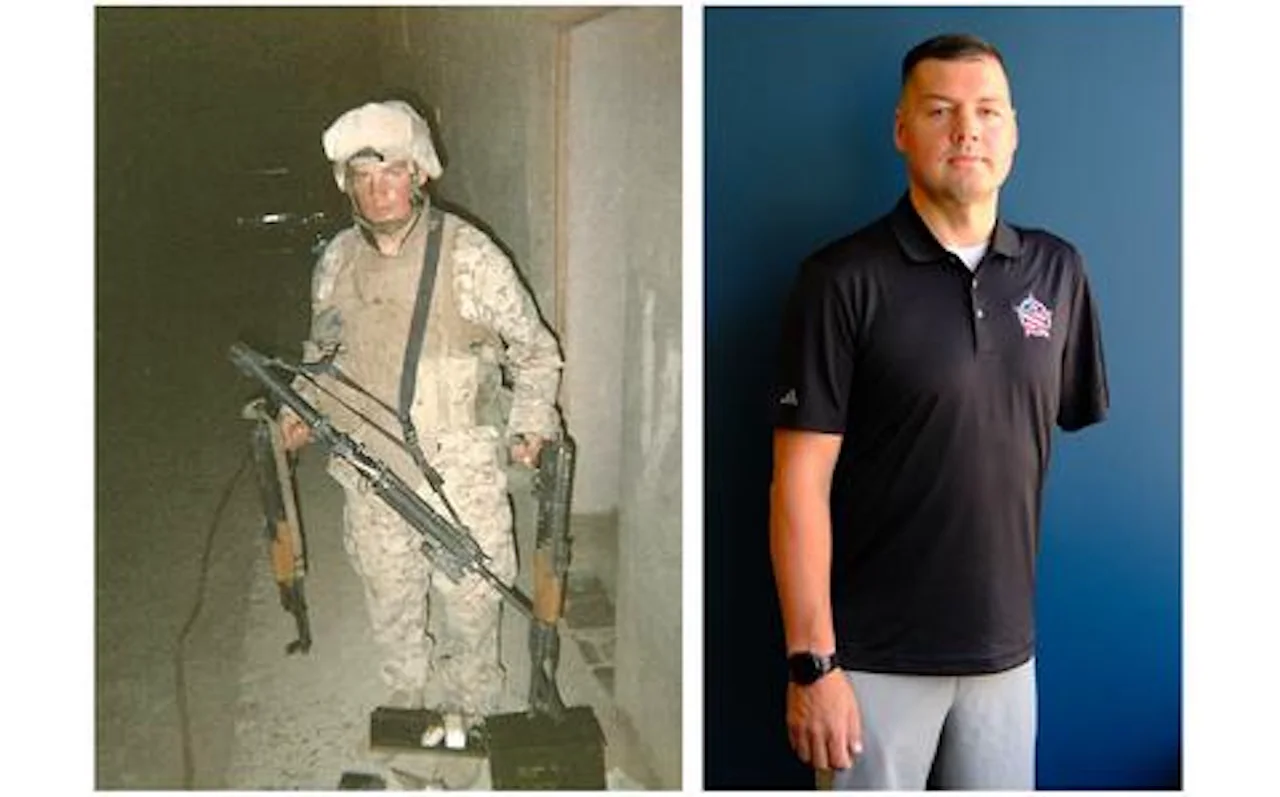 Adam Kisielewski, left, as a Marine Corps sergeant in 2006 just days before suffering life-threatening injuries in a bomb blast in Iraq. Kisielewski, right, in 2024 at the Reserve Organization of America's offices in Washington, D.C. He advocates for the passage of the Richard Star Act. (Adam Kisielewski/Wounded Warrior Project)
Staff Sergeant Dan Nevins, U.S. Army: Both legs amputated after an IED in 2004. Discovered his retirement pay would evaporate dollar-for-dollar against his disability compensation.
Staff Sergeant Latoya Lucas, U.S. Army: Nearly killed by an RPG attack in 2003 during her deployment to Iraq. The explosion left her with lasting injuries and trauma that would change her life forever. Despite her sacrifices and service-connected disabilities, she sees the offset every year on her DoD statement—a reminder she calls a "long-standing injustice." Lucas continues to advocate for fellow veterans while raising a child as a single mother, her financial security compromised by a system that penalizes her for being wounded in service to her country.
 SSG Latoya Lucas recovering in a military hospital in Iraq after being severely wounded by an RPG attack in 2003. (DAV)
The Solution: The Major Richard Star Act
What It Does
The Major Richard Star Act (H.R. 2102 | S. 1032) would:
- End the "wounded-vet tax": Fully restore retirement pay alongside disability compensation for Chapter 61 medical retirees
- Provide concurrent receipt: Allow combat-wounded veterans to receive both earned benefits simultaneously
- Honor our promise: Recognize that wounds sustained in service to our nation should never reduce earned benefits
The Numbers
Cost: The Congressional Budget Office estimates the legislation will increase direct spending by more than $8 billion over the next 10 years — roughly $1 billion per year, just 0.11% of the DoD budget. On average, combat-injured retirees would have approximately $1,200 of their military retirement restored per month.
For perspective, this is less than Pentagon spending on:
- Advertising and recruitment
- Cost overruns on weapons systems
- Maintenance of unused military facilities
Congressional Support:
- 296 House cosponsors (out of 435)
- 76 Senate cosponsors (out of 100)
- Recent Progress: Sen. Jon Tester (D-Mont.), chairman of the Senate Veterans' Affairs Committee, filed an amendment to the 2025 National Defense Authorization Act in July 2024, with language from the Major Richard Star Act
Congressional Support
Bipartisan backing for the Major Richard Star Act
House of Representatives
Senate
Overwhelming bipartisan support from 69.5% of Congress
So why hasn't leadership scheduled a vote?
"We Can't Afford It"? Try Again, Congress
Congress just clawed back $9.4 billion in previously approved funds—enough to fund this Act nearly ten times over.
The money exists. The backbone does not.
Recent Congressional Spending for Context
While claiming they "can't afford" $1 billion for wounded warriors, Congress has:
- Approved billions in foreign aid packages
- Funded numerous infrastructure projects
- Allocated massive spending for various domestic programs
The Major Richard Star Act represents less than 0.02% of the federal budget. This isn't a money problem—it's a priority problem.
Cost of Justice vs. Everything Else
Annual spending comparison (in billions USD)
F-35 Program (Total)
Most expensive weapons system in history
Pentagon Advertising (Annual)
Military recruitment marketing
Unused Military Facilities (Annual)
Maintaining empty bases and buildings
Major Richard Star Act (Annual)
Justice for 53,000+ combat-wounded veterans
Restores an average of ~$1,200/month to each combat-wounded veteran
We can afford justice for our wounded warriors
The money exists. The backbone does not.
If Full Passage Proves Impossible
Should Congress lack the moral courage to pass the entire bill, two narrower paths still deliver meaningful justice:
Option 1: 50%+ VA Rating
- Extend concurrent receipt to Chapter 61 retirees rated 50% or higher
- Mirrors current CRDP rules for 20-year retirees
- Cost: ≈$600–700 million per year
- Impact: ~30,000 combat-wounded veterans
Option 2: 100% VA Rating Only
- Focus solely on the most severely disabled (100% VA-rated)
- Cost: <$350 million per year
- Impact: ~10,000–15,000 warriors
- Political appeal: Bulletproof and morally undeniable
Even a partial victory means real money in the pockets of families who've sacrificed enough.
The Moral Imperative
What Message Are We Sending?
If lawmakers won't fight for our most severely wounded veterans, what message are they sending those still in uniform?
That being wounded in action is somehow less honorable than making it to retirement unscathed?
That your sacrifice to this nation comes with a financial penalty?
That Congress values accounting ledgers more than Purple Hearts?
The Promise We Made
When these warriors raised their right hands and swore an oath, we made a promise in return:
"If you give everything in service to this nation, we will take care of you."
The offset breaks that promise every single month.
In Their Own Words
The impact of this injustice is best captured in the words of those who live it every day:
"I was forced out of the military. The decision on making the military my career was taken away from me. Because of that, I had to forfeit my military retirement pay. We are asking for the same consideration. We did not have a choice about leaving the military."
— Adam Kisielewski, former Marine Corps Sergeant
"As a platoon leader, I was charged with bringing guys home safe. But I was unable to complete that mission. And I had no choice whatsoever in continuing my military career. Having my retirement pay reduced to nothing because I am receiving disability compensation negates my service and commitment."
— Ryan Kules, former Army Captain
"We're asking for something we feel we earned when we were injured."
— Adam Kisielewski
"Every year since I retired, I see the pay that was offset when I receive my end-of-year statement from the [Department of Defense]. We need to fix this long-standing injustice for veterans who had their military careers cut short due to combat-related injuries like myself."
— Latoya Lucas, former Army Staff Sergeant
Lucas medically retired in 2003 after suffering a near-fatal blow from a rocket-propelled grenade that directly hit her Humvee. (For more on Lucas' remarkable journey and recovery, read "Here for a reason".)
Take Action Now
1. Contact Your Representatives
Find your representatives: Use Congress.gov to locate your House representative and Senators.
Demand answers:
- Why aren't they cosponsoring the bill?
- When will leadership schedule a floor vote?
- How do they justify the offset to wounded warriors?
2. Use the One-Click Tool
MOAA's Action Center: Send a professional message to your representatives in 60 seconds → https://moaa.quorum.us/campaign/43784/
3. Read the Bills
House Bill H.R. 2102: https://www.congress.gov/bill/119th-congress/house-bill/2102
Senate Bill S. 1032: https://www.congress.gov/bill/119th-congress/senate-bill/1032
4. Share Your Story
Are you one of the 53,000+ combat-injured retirees affected by this offset?
Share your story:
- Post on social media with #MajorRichardStarAct
- Contact local media outlets
- Reach out to veteran organizations
- Comment below with your experience
Every voice makes us louder. Every story makes the injustice more real.
Organizations Fighting for Change
Leading the Charge
Military Officers Association of America (MOAA): Primary legislative advocate for the Major Richard Star Act
Iraq and Afghanistan Veterans of America (IAVA): Strong supporter pushing for congressional action
Veterans of Foreign Wars (VFW): Longtime advocate for concurrent receipt expansion
Disabled American Veterans (DAV): Fighting for fair benefits for disabled veterans
Join the Fight
These organizations need your:
- Membership to increase political clout
- Advocacy to amplify the message
- Donations to fund lobbying efforts
- Stories to humanize the issue
The Finish Line is in Sight
Major Richard Star fought until his final breath to end this injustice. He didn't live to see victory, but his name ensures the fight continues.
296 House cosponsors. 76 Senate cosponsors. We have the votes. We need the will.
Every month this bill sits in limbo, 53,000+ wounded warriors receive smaller checks than they've earned. Every month Congress delays, families struggle to make ends meet because bureaucrats decided that wounds are worth less than time in service.
The Choice is Clear
Congress can:
Option A: Continue to penalize our most wounded warriors while claiming to "support the troops"
Option B: Pass the Major Richard Star Act and finally keep our promise to those who kept theirs
Finish Major Star's Mission
The math is simple. The morality is clear. The votes are there.
What's missing is the political courage to do what's right.
Contact your representatives today. Make it clear that supporting wounded warriors isn't optional—it's the absolute minimum we owe those who've given everything for this nation.
Keep our promise to warriors who gave everything—but lived to fight another day.
The time for action is now. The cause is just. The warriors are waiting.
Jeremy Cleland is a retired Green Beret Medical Sergeant, AI engineer, and veteran advocate. He continues to fight for those who fought for us through technology, policy advocacy, and unwavering commitment to the warrior ethos.
Tags: #MajorRichardStarAct #Veterans #ConcurrentReceipt #CombatInjured #KeepOurPromise
Additional Resources
- Congressional Bills: H.R. 2102 | S. 1032
- Take Action: MOAA Action Center
- Learn More: Military.com Coverage
- Contact Congress: Find Your Representative
- Recent Coverage: Stars and Stripes - Combat-injured veterans face new battle at home
- Veteran Stories: DAV - Combat-wounded veteran reflects on how war changed her life