The statistics and where they come from
“Speed to lead” is the gap between a new inquiry and your first real attempt to reach that person. A homeowner submits a quote form at 9:02. Someone from your shop calls or texts at 9:09. That is a seven-minute speed to lead. Two studies dominate the citations. They measure different things, and they are almost always mashed together online.
The first is the InsideSales.com / MIT Lead Response Management study, presented in 2007 by Dave Elkington and James Oldroyd (then a faculty fellow at MIT Sloan). It examined three years of call data across six companies that generate and respond to web leads—more than 15,000 leads and more than 100,000 call attempts. It asked when companies should call web-generated leads for optimal contact and qualification rates, and stated plainly that it did not address close ratios.
The second is Harvard Business Review’s March 2011 article “The Short Life of Online Sales Leads” (Oldroyd, McElheran, and Elkington; Vol. 89, No. 3). That piece reports an audit of 2,241 U.S. companies that received a web-generated test lead, plus a separate analysis of 1.25 million sales leads from 29 B2C and 13 B2B companies in the U.S.
| Statistic | Study | Year | Sample | What it measured | Common misquote |
|---|---|---|---|---|---|
| Contact odds ~100× higher at 5 min vs 30 min | Lead Response Management (InsideSales / Oldroyd at MIT) | 2007 | 6 companies; 15,000+ web leads; 100,000+ call attempts | Odds of reaching a live person | Credited to Harvard; treated as a close-rate or conversion claim |
| Qualification odds ~21× higher at 5 min vs 30 min | Same | 2007 | Same | Odds of qualifying (company-defined; often appointment-ready) | “21× more likely to close” or “convert” |
| Contact odds drop >10×; qualify odds drop >6× across the first hour | Same | 2007 | Same | Decay inside the first hour | Folded into a vague “five-minute rule from Harvard” |
| After ~20 hours, additional dials hurt contact/qualify odds | Same | 2007 | Same | Late-stage calling effect | Almost never quoted |
| Average response 42 hours (among responders within 30 days) | Harvard Business Review audit | 2011 | 2,241 U.S. companies, test web leads | How long firms took to respond | Treated as today’s contractor benchmark |
| 37% within 1 hour; 16% in 1–24 hours; 24% took >24 hours; 23% never responded | Same audit | 2011 | Same | Response distribution | Selective quoting of only the fast share |
| Nearly 7× as likely to qualify within 1 hour vs 1 hour later; >60× vs waiting 24+ hours | Same HBR piece, separate lead dataset | 2011 | 1.25M leads; 29 B2C + 13 B2B firms | Qualification as a meaningful conversation with a key decision maker | Presented as a five-minute finding |
Those rows are the usable core. Everything else in this category should earn its place the same way: named study, year, sample, and outcome definition in the same sentence.
What the research does not say
It does not say you are 21 times more likely to close a job in five minutes. The 2007 study measured contact and qualification odds, not closed sales. Qualification meant whatever each participating company used as “willing to enter the sales process”—often an appointment—not a signed contract.
It does not say Harvard discovered the five-minute rule. The 5-versus-30-minute multiples are from the 2007 InsideSales/MIT work. HBR’s own headline contribution is the slow-response audit (42-hour average; 23% never replied) and the one-hour qualification finding on a different dataset.
It does not transfer cleanly to every local trade. Both foundational datasets are web-generated leads, with a heavy B2B flavor in the 2007 work and a mix of B2B and B2C industries in the 2011 analysis. A homeowner requesting an HVAC quote is not the same population. The direction—faster first contact, higher odds of a real conversation—is the part that travels. The exact multiples are not a promise for your market.
The studies are also old; treat the direction as durable and the exact multiples as dated.
Two popular claims fail a source check and are not used here: “78% of customers buy from the first responder,” and the “391%” conversion lift. If a deck cannot name the study, sample, and outcome, leave the number off.
What this means for a local service business
Translate the research into channels you already run.
Phone calls. A live answer during business hours is still the strongest first contact. A missed call that sits until tomorrow is the local version of the slow web-lead problem the studies measured. Return the call the same day when you can; when you cannot, an immediate text or voicemail that names a next step is better than silence.
Web forms. This is the closest match to the original studies. Route form notifications to a phone that a person actually carries. Auto-acknowledge the submission in minutes, then aim for a human callback measured in minutes during open hours—not “someone will be in touch.”
Website chat and text. Instant reply is table stakes on these channels because the visitor is already in a conversation. Platform data from Small Business Chatbot (vendor data; 7,159 website chats across 19 U.S. small businesses, February 2025–September 2026) found 38% of chats arrived outside weekday 8 a.m.–6 p.m. local time, and after-hours visitors left a phone or email about as often as daytime visitors (63% vs 64%). Treat that as directional evidence that evenings and weekends are not empty—not as a national benchmark.
Emergency versus planned work. A flooded basement at 9 p.m. and a kitchen remodel inquiry behave differently. Urgent jobs punish delay harder; planned jobs still punish “we’ll call next week.” Set different targets by job type, then measure whether you hit them.
Google can now call businesses on a customer’s behalf when availability or pricing is not clear online. That raises the same operational bar: someone (or something) has to answer, qualify, and hand off cleanly. See why Google may be calling your business.
Measure your own response time
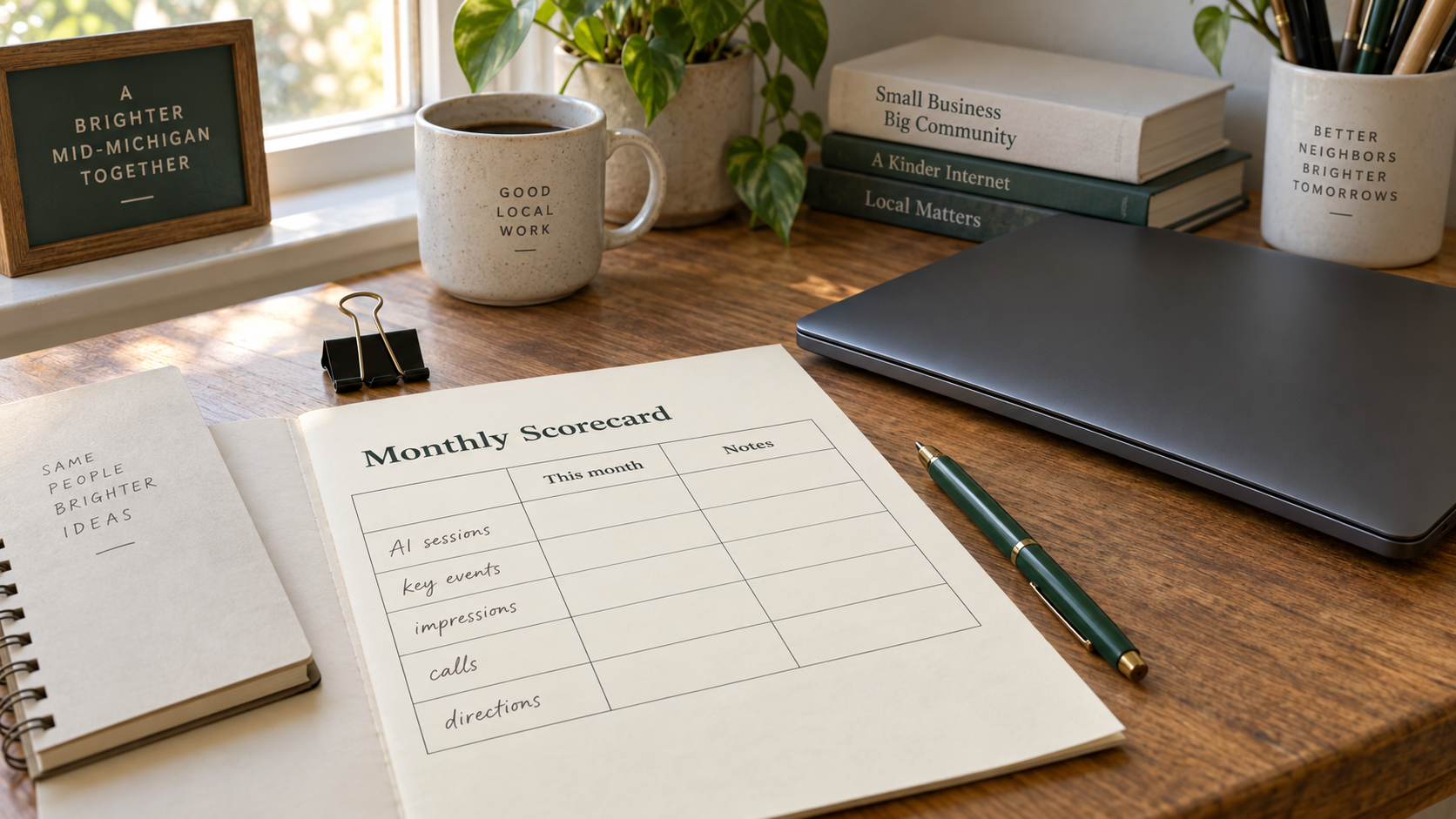
Borrowed multiples are less useful than your own median. For one full month, log every inquiry that should produce a human reply.
| Channel | Timestamp in | First human contact | After-hours (Y/N) | Notes |
|---|---|---|---|---|
| Phone / missed call | ||||
| Web form | ||||
| Website chat | ||||
| SMS / text | ||||
| Marketplace / third-party lead |
Pull timestamps from form notification emails, call logs, voicemail systems, and chat transcripts. Record the first genuine outbound attempt by a person—not the auto-reply. Report the median time to first human contact, not only the average; one three-day outlier hides a week of good behavior. Split by channel and by after-hours versus daytime. Optionally compare booked-estimate rate for your fastest quartile versus your slowest. That comparison, on your books, beats any slide deck.
Keep inquiry response separate from acquisition reporting. Speed-to-lead is an operations metric. Pair it with how you track AI and search traffic in GA4 and Search Console so you know both where demand arrives and how fast you answer it.
Where AI helps, and where it doesn't
Automation helps most where the studies show delay is fatal: the first minutes, and the hours when nobody is in the office.
Instant acknowledgement
An auto-text or auto-email that confirms receipt, restates what was asked, and names the next step (callback window, booking link, or emergency line) closes the “did anyone get this?” gap. It is a receipt. It is not a substitute for human contact, and it should not be counted as your speed-to-lead clock.
After-hours capture
Chat or an AI answering path can collect name, phone, job type, address or service area, and urgency when the shop is closed. Vendor chat data above suggests a meaningful share of website conversations already arrive after hours. For how to scope that tool without treating every vendor claim as research, see AI receptionist for small business.
Qualification questions before callback
A short script—service needed, timing, photos if relevant, budget range if you ask for one—saves the first live conversation from starting at zero. Keep the list short enough that a tired visitor still finishes it.
What still needs a person
Quoting, judgment about scope, exceptions to your service area, and the relationship that turns a conversation into a booked job still need a human. The research above rewards reaching and qualifying people faster. It does not say a bot should close the sale.
Rules to know before automating follow-up
This section is informational, not legal advice. Get counsel before you automate outbound calls or texts at scale.
In February 2024 the FCC confirmed that AI-generated voices count as “artificial or prerecorded voice” under the Telephone Consumer Protection Act. Outbound calls that use those technologies generally need the called party’s prior express consent (prior express written consent when the call is telemarketing), plus identification and opt-out practices that already apply to artificial or prerecorded voice calls. The ruling does not ban AI voice outright; it places those calls under the existing TCPA framework. Inbound answering while a customer is calling you is a different situation from an AI agent dialing out later.
Text follow-ups have their own consent and opt-out rules. Do not treat “they filled out a form” as automatic permission for every channel and every message type. Document consent, offer an easy stop, and have a lawyer review the sequence before you turn it on.
A simple speed-to-lead routine for a small team
You do not need new software to start. A three-to-ten-person shop can run this on phones and email you already own.
- One inbox, one phone. Route form notifications, chat alerts, and the main business number to a single shared queue someone owns during open hours.
- Auto-acknowledge in minutes. Every form and chat gets an immediate receipt with a next-step sentence. Missed calls get a short callback or text as soon as practical.
- Human callback target by lead type. Example starting targets (set your own, then measure): emergency phone—live or same hour; daytime web form—human contact within 15 minutes; after-hours inquiry—acknowledge immediately, human contact first thing next open window.
- Stop hammering cold leads. The 2007 study found that after about 20 hours, additional dials hurt contact and qualification odds. Switch channel (text or email) or pause rather than adding rings on day three.
- Weekly review. Ten minutes: median time-to-first-human by channel, share of after-hours inquiries, and how many never got a human attempt. Fix routing before you buy another tool.
Faster response will not fix a thin website, empty Business Profile, or missing citations when buyers check you in search or an assistant. Speed and AI SEO for small business are related jobs: get found accurately, then answer when someone reaches out.