Three kinds of local search, and which ones AI Overviews answer
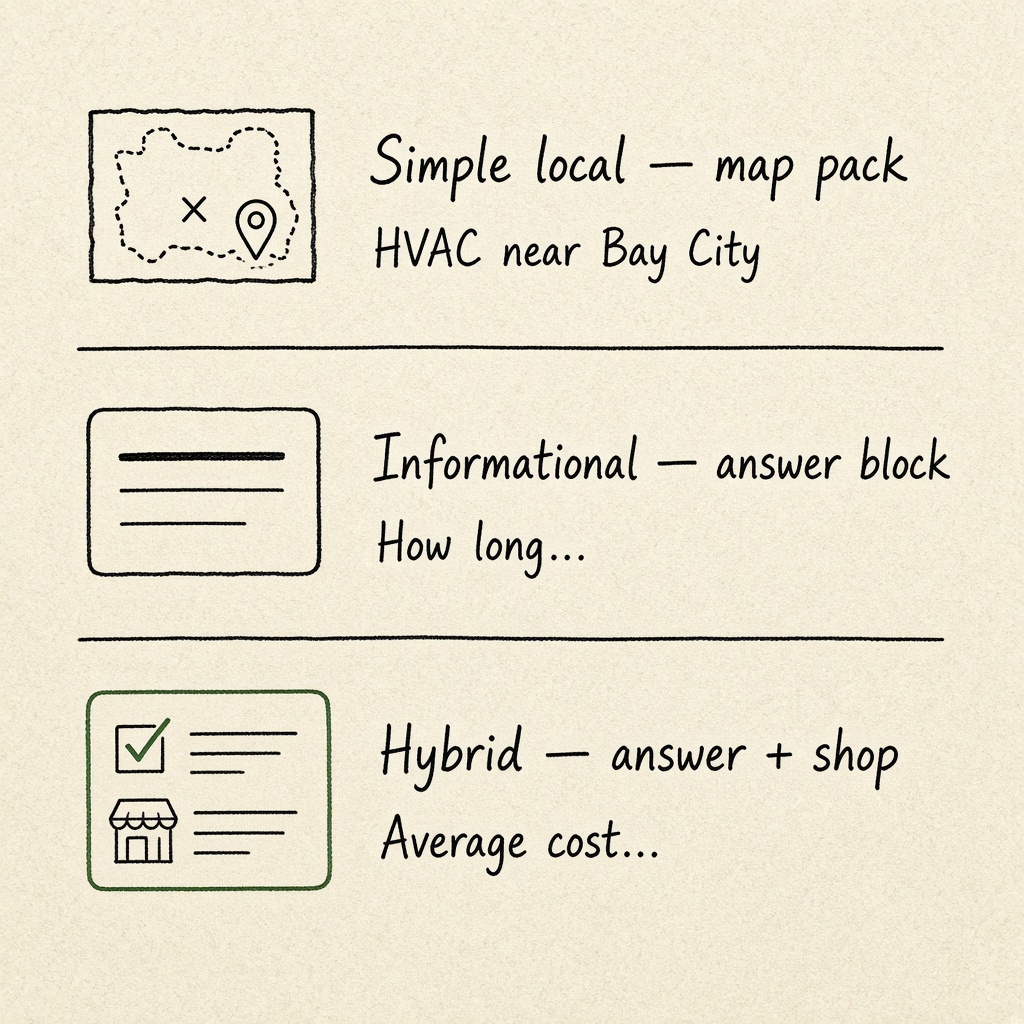
If you run a Mid-Michigan trade, salon, or clinic, you already know that not every Google search is the same job. "Plumber near Midland" is a shortlist. "How long does a water heater replacement take in Midland?" is research. "Average cost of a water heater replacement in Midland" is both: the person wants numbers and a local shop.
That split matters more than any single "AI Overviews killed local SEO" headline. In Whitespark's Q2 2025 study of 540 local-business-type queries across three US cities and six industries, AI Overviews appeared on about 15% of simple local-intent queries, about 92% of informational queries, and about 97% of hybrid queries. Local packs showed the inverse pattern: about 93%, 6%, and 17% respectively. Those rates are from Q2 2025; we did not find a comparable 2026 re-run with the same intent split, so treat them as dated evidence, not a live dashboard.
| Query type | Mid-Michigan-style example | AIO share (Whitespark, Q2 2025) | What the searcher often sees first | Which of your assets matters most |
|---|---|---|---|---|
| Simple local | "HVAC repair near Bay City" | ~15% | Map pack / local results | Business Profile + reviews |
| Informational | "How long does a color correction take in Saginaw?" | ~92% | AI Overview | Clear answers on service pages (and third-party pages Google can cite) |
| Hybrid | "Average cost of a furnace tune-up in Midland" | ~97% | AI Overview | Service pages with cost ranges, timing, and service area you can stand behind |
Sort a week's real inquiries into those three buckets and you will know which pages to fix first. Map-pack work still earns the "near me" calls. Informational and hybrid work is where AI Overviews are most likely to sit above your site.
Whitespark's overall average in that same Q2 2025 sample was about 68% of local-business-type queries showing an AI Overview, with local packs on about 39%. That 68% figure is useful only with the intent split above it. Averaging a nearly empty map-pack bucket with a nearly full AI Overview bucket produces a scary headline and a bad plan. Industry also mattered more than city in their set: prevalence looked similar across Houston, Phoenix, and Denver for a given vertical, while real estate local-intent queries were an outlier with AI Overviews on as much as half of those local queries. Run a handful of your own category searches before you rewrite the whole site around someone else's average.
What changed
Answers above the map pack
When an AI Overview fires, it takes screen space that used to belong to organic listings and, on some queries, sits above or beside the local pack. Search Engine Land's local AI guide (summarizing the same Whitespark pattern) notes that these blocks are bulky and can push classic results down the page. That is a visibility change on the results page, not proof that every business lost customers. Clicks to blog-style pages are the most exposed; calls and directions are a different story.
For a Bay City HVAC company, that usually means: "AC repair near me" still looks like a map problem, while "how much does a new AC install cost in Bay City" looks like an answer problem. Budget time for both; do not treat every traffic dip as a map-pack failure.
AI Mode and query fan-out
AI Mode is Google's conversational search surface for longer, multi-part questions. Google's May 2026 Search Central guide describes query fan-out: the system issues related searches across subtopics and sources, then grounds the answer in the normal Search index. For a local owner, the practical meaning is simple. A customer can ask one question that expands into cost, availability, and nearby providers without typing three separate searches. Your pages still have to be indexed and eligible for a snippet; there is no separate "AI Mode SEO" file to upload.
Google's companion AI-features documentation is explicit: there are no additional technical requirements beyond being indexed and snippet-eligible, and "specific optimization isn't required" for AI Overviews and AI Mode. Foundational SEO still applies. New file formats and AI-only rewrite projects do not.
Ask Maps
In March 2026 Google announced Ask Maps: a conversational Maps experience that answers multi-constraint questions using place data, attributes, and community reviews (for example, charging nearby without a long coffee wait, or a lit tennis court tonight). Rollout started in the US and India on mobile, with desktop to follow. If your hours, attributes, or services are wrong on the profile, Ask Maps can repeat them as current. Clean the source of truth; do not invent a new Maps-only content strategy.
Google has also been connecting Business Profile to the Gemini app so owners can draft review replies, update hours, and ask about profile performance (gradual global rollout; availability limits apply). That is an operations convenience, not a ranking shortcut—but it is another reason to keep the profile accurate enough that an AI drafting from it does not invent closed Sundays.
Google can call you on a customer's behalf
Google's help documentation states that AI Mode can research service costs and open appointment slots, complete forms, and call businesses when the needed detail is not online; customers can type "don't call" if they prefer web-only checks. Business Profile help adds that Google may call to book appointments, check restaurant wait times, or confirm price and availability, that calls are recorded, and that businesses can opt out. In the US, Google lists exclusions for Indiana, Louisiana, Minnesota, Montana, and Nebraska. Google states it will never ask for payment, card numbers, or passwords on these calls.
If a robot is calling about price or availability you never published, the fix is to put those facts where Google can read them—or to answer the call. Leaving pricing and earliest availability only in a voicemail greeting is how you get an agentic call you were not ready for. See why Google may be calling your business.
Consumers use AI tools, then verify
BrightLocal's Local Consumer Review Survey 2026 (n=1,002 US adults, self-reported) found that 45% of consumers used ChatGPT or another generative AI tool for a local business recommendation in the past year, up from 6% the year before. In BrightLocal's related channel study (n=1,227 US consumers who had searched for a local business in the prior three months), only 18% of AI users felt ready to contact the AI-recommended business without further checking; of those who started on an AI tool, 43% went on to check Google and 39% checked social media. Only 2% of AI-first searchers used AI as their only channel. AI can put you on a shortlist. The profile, reviews, and website still have to survive the verification step.
That is the 2026 local reality in one sentence: more people ask an assistant for a name, then check whether the name looks real.
What didn't change
Google's position, stated in its AI features documentation and May 2026 optimization guide, is that AI Overviews and AI Mode draw on the same Search index. A page must be indexed and eligible for a snippet. There are no additional technical requirements and no special markup for Google's AI features. Google tells site owners they can ignore llms.txt, content "chunking," AI-only rewrites, and inauthentic "mentions" as requirements for Google Search. Business Profile and Merchant Center data are named as inputs for local and product answers.
Local ranking still rests on the model Google publishes for Business Profile results: relevance, distance, and prominence (Google's help page also summarizes that third factor as popularity). Complete categories, accurate hours, reviews, and web visibility still matter for the map pack. AI Overviews did not invent a replacement local algorithm, and Google still says there is no way to request or pay for a better local ranking.
When a local AI Overview does name businesses, it mostly names ones already on the page. In Spearleaf Research's 2026 study covering 215 markets, local AI Overviews that fired named about 1.8 businesses on average, and 87.6% of those names were already in the same page's local pack (95% CI 82.9–92.1%, n=127 markets); 1,182 of 1,683 citations pointed to google.com itself. Figures are from Spearleaf's published excerpt of that study.
So if you are invisible in the pack for "salon near Saginaw," an AI Overview is unlikely to invent you as the answer for "best balayage in Saginaw" and keep you there. Pack work and answer-page work reinforce each other; they are not a replacement for each other.
Same index, same eligibility, same local model. AI Overviews change which queries get an answer block first; they do not create a separate Google ranking system for local businesses.
Where local traffic went (one small study, directional)
Tracsoft reviewed year-over-year analytics for 18 established local businesses and nonprofits it manages (Southeast-concentrated client list; medians, not averages). After AI Overviews, search traffic grew a median of 6.6%, Google Business Profile calls/directions/views grew 21.4%, blog and article pages fell 20.0%, and service pages grew 5.9%. Homepage traffic (their stand-in for branded visits) grew 5.9%. Local metro traffic grew 11.9% while out-of-state traffic fell 10.5%. Tracsoft is clear about the limits: one agency's list, visits not revenue, not a national census. Nonprofits in their tiny subset mostly lost traffic; treat that as a warning for education-heavy sites, not a rule.
What it suggests, if your pattern looks similar: general how-to blog traffic is the softest; service pages, branded visits, and profile actions are more resilient. What it cannot prove: that every Mid-Michigan shop will see the same percentages, or that sessions are a complete measure of demand.
What to do differently for local SEO in 2026
Move answers from blog posts onto service pages
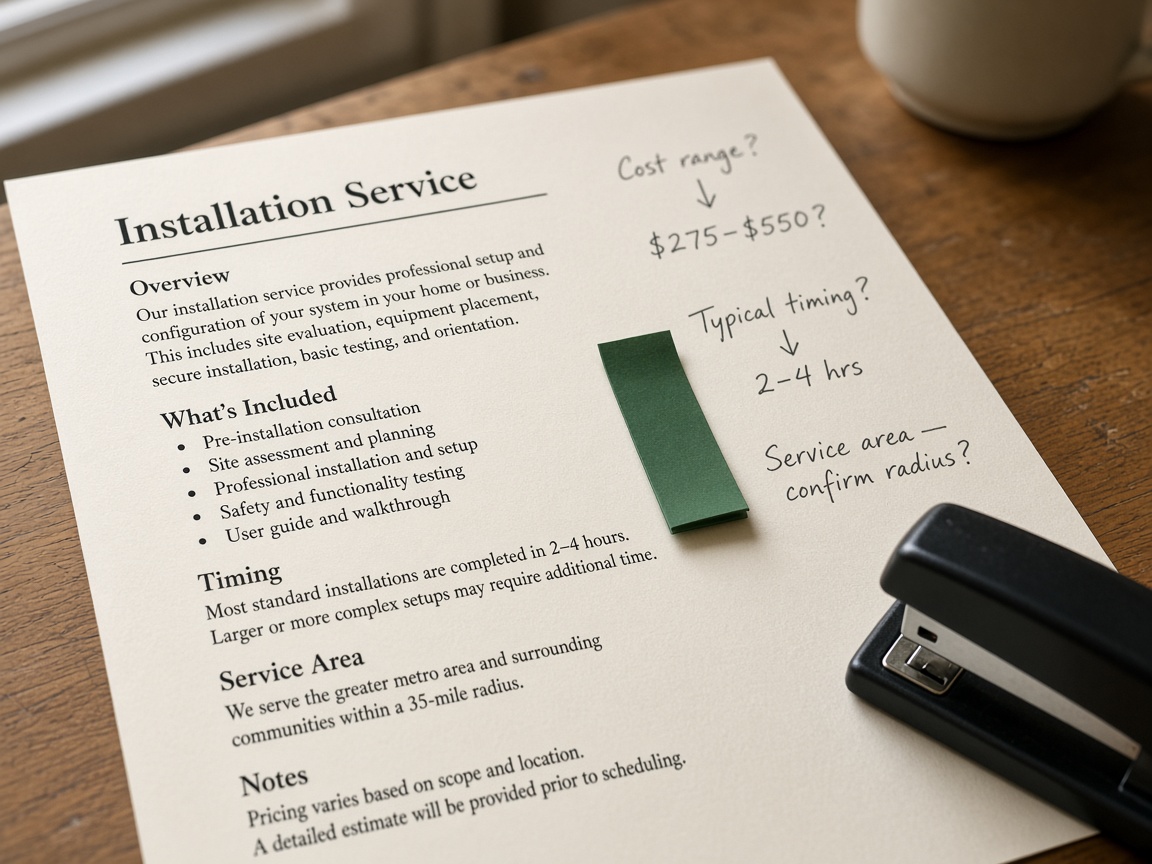
Put cost ranges you can stand behind, typical timing, service area, and what's included on the page for that service—not only in a generic blog post. Hybrid queries are where Whitespark saw AI Overviews almost every time in Q2 2025. If the only place you say "furnace tune-up in Midland usually runs…" is a 2019 article, that is the page Google (and customers verifying an AI answer) may still find.
You do not need a separate "AI content" site. You need the page a customer would bookmark after an AI shortlist: what you do, where you work, what it roughly costs, how long it takes, and how to book. If a number changes seasonally, date the page or say so. An outdated range repeated in an Overview is worse than no range.
Treat the Business Profile as a data source for AI answers
Google names Business Profile as an input for local generative answers. Hours, categories, services, attributes, photos, and review replies are not just map-pack hygiene; they are facts assistants can repeat. See Google Business Profile checklist for AI search.
Clean up stale pages and listings
Ask Maps and AI answers lean on attributes and reviews. Stale holiday hours, closed service lines, or old city pages that still rank can be repeated as current. Fix or remove them. Agency anecdotes about Ask Maps stale-data incidents circulate online; treat those as illustrations of the risk, not as Cleland & Co. measurements.
Make sure you're eligible
Confirm the site is indexable, pages you care about can show a snippet, and Search Console's inclusion setting for Search generative AI features is on (Google's May 2026 guide). That is eligibility, not a ranking guarantee. If a page is blocked from crawling, noindexed, or stripped of snippets, it cannot support an AI Overview citation no matter how well written it is.
Measure calls, directions, and AI impressions—not sessions alone
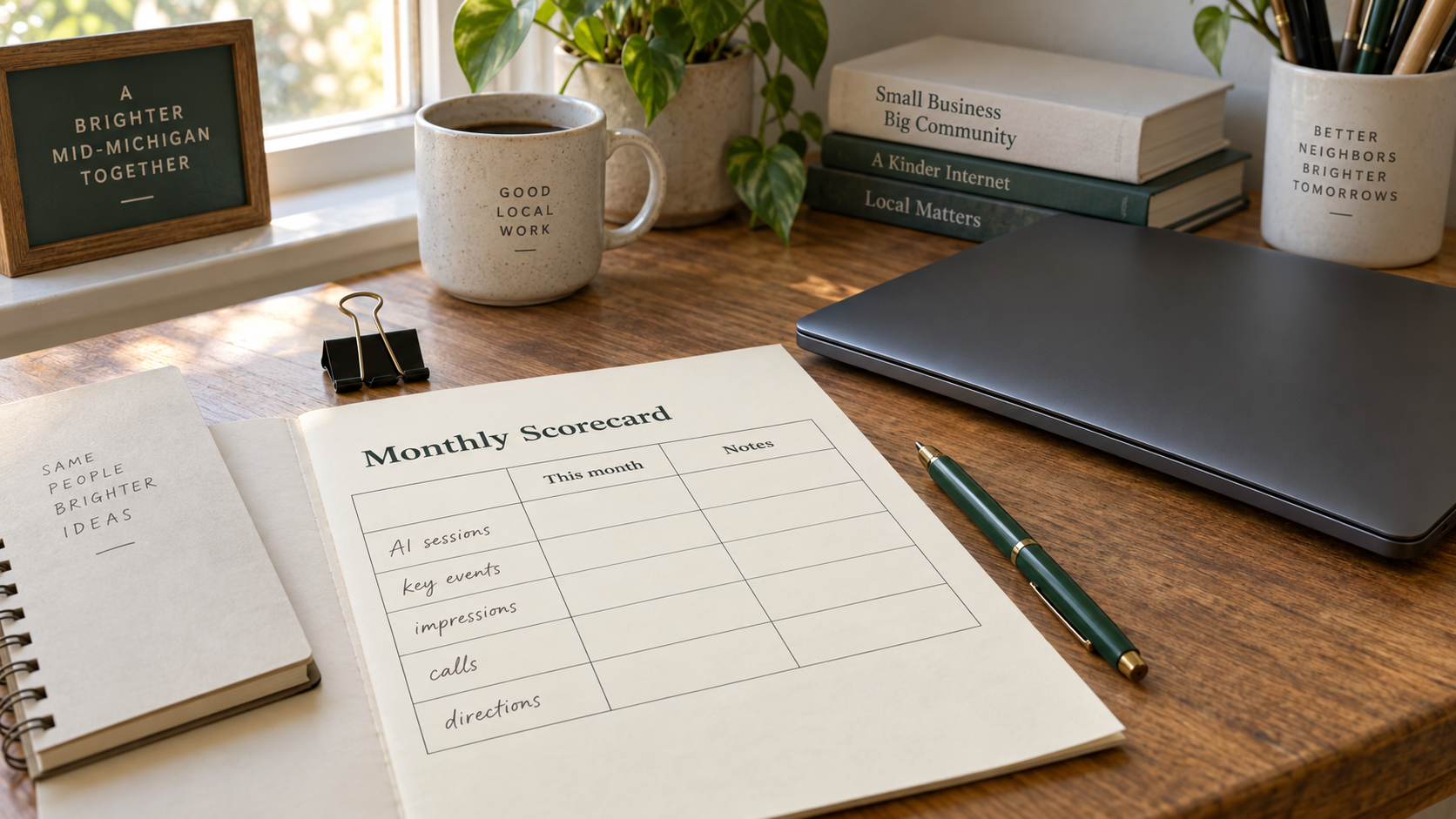
Search Console's Generative AI performance report (launched 2026-06-03) shows impressions from AI Overviews and AI Mode by page, country, device, and date—not clicks, CTR, or queries. Impression counting differs between AI Overviews (the link must be scrolled or expanded into view) and AI Mode (follow-ups can create new impressions), as Search Engine Journal summarized from Google's docs. GA4's Default Channel Group includes an AI Assistant channel for referrers such as ChatGPT, Gemini, Copilot, and Grok; it excludes Google's AI Overviews and AI Mode (those remain under Organic Search when they send traffic). For a local shop, Business Profile calls and direction requests are often the clearer outcome signal than sessions. See tracking AI traffic in GA4 and Search Console.
- Rewrite each core service page so cost ranges, timing, service area, and inclusions are stated plainly.
- Audit Business Profile hours, categories, services, and attributes as AI inputs, not only map-pack fields.
- Remove or update stale holiday hours, retired services, and outdated city pages.
- Confirm indexability, snippet eligibility, and Search Console generative AI inclusion.
- Track profile calls and directions plus Search Console AI impressions; do not manage the business on sessions alone.
What to ignore
- llms.txt and "chunking" as Google requirements. Google says neither is needed for its AI features. An optional llms.txt on a site is fine to host; it is not a Google ranking lever.
- One headline "AI Overviews appear on X% of all searches." Prevalence varies by intent, industry, date, and method. Quote the query type and the study date, or don't quote a single percentage.
- Guaranteed AI Overview placement. No vendor can sell you a fixed spot in an AI Overview. Google also says there is no paid path to a better local ranking.
Local SEO in 2026 is still worth doing if customers still find you through Google Search and Maps—which BrightLocal's channel work says most local searchers still use. The work is narrower: win the map pack for simple local intent, put answerable facts on service pages for informational and hybrid intent, keep the profile accurate enough for Ask Maps and agentic calls, and measure outcomes that match how people actually book. For the wider AI-search landscape beyond Google's surfaces, see AI SEO for small business.