Best local citation sites: five 2026 studies, side by side
“Best local citation sites” used to mean a checklist of fifty places to paste your NAP. The useful question in 2026 is narrower: which domains do the assistants actually cite when a buyer asks for a local business — and where do the studies disagree?
Five transparent studies cover overlapping ground with different samples and engines. None promises a ranking. Together they show what is durable and what is a dated snapshot.
| Study | Sample (stated) | Engines | Headline finding | Caveat |
|---|---|---|---|---|
| BrightLocal, 2026 | ~60,970 checks across 1,355 US/UK/AU locations | AI Overviews, AI Mode, ChatGPT | Google Business Profile (google.com) 28.63% of citations; Yelp in 80% of ChatGPT local answers; ~93% of cited domains were business websites | Vendor tool; ~20% restaurants may skew hospitality directories |
| Spearleaf, 2026 | 215 markets; card ratings validated same-day | ChatGPT (+ AIO / AI Mode notes) | Most-cited: reviews.birdeye.com, expertise.com, threebestrated.com; verticals (Carfax, Zocdoc) matter | Saved capture is an excerpt; live page blocked by Cloudflare on 2026-09-26 |
| AskedAbout, 2026 | 173 audits / 1,024 answers (Jun–Jul 2026) | ChatGPT citations; Perplexity for named businesses | Directories: 25.4% of ChatGPT sources, 73.6% of answers; 0.27% of named recommendations | Convenience sample; classifier undercounts unknown directories |
| Complete SEO, Sep 2026 | 44,988 answers; 35 home-service trades; 24 metros | ChatGPT | angi.com 16.5%, expertise.com 12.8%, bbb.org 12.3%, reddit.com 11.3%; identical lists 3.6% of the time; places card on 95.5% of answers even with web search off | Home services only; city in prompt, not a simulated local device |
| Steady Demand Ledger (updated 2026-09-09) | 1,500 queries × 50 US metros × 10 verticals | Gemini API + grounding; ChatGPT Search re-run | Gemini own-site 49.6%; ChatGPT own-site 10.5% / directories 46.0%; domain overlap 8.3%; same top business 4.9% | Agency study; Gemini API vs ChatGPT consumer surface |
Read on 2026-09-26, Steady Demand's live ledger still carries the September 9 update: Reddit's Gemini share 13.7% to 1.7%, directories 10.4% to 19.1%, and the ChatGPT August 20 re-run that took reddit.com from 41.7% to zero (0 of 334 on a same-day follow-up). Those numbers have not been withdrawn.
Where the studies agree
Directories and review aggregators feed ChatGPT. BrightLocal found Yelp in 80% of ChatGPT's local answers. AskedAbout's ChatGPT citation cut put directory and aggregator domains at 25.4% of domain appearances and in 73.6% of answers. Complete SEO's home-services scrape put angi.com, expertise.com, and bbb.org at the top of attached source domains. On a separate arm with web search turned off, Complete SEO still saw ChatGPT's places card on 95.5% of answers—so the card is not just a byproduct of live web search. Steady Demand's September ChatGPT re-run put general business directories at 46.0% of citations against 10.5% for the business's own site.
Google's AI cites Google. Across BrightLocal's mix, Google Business Profile (google.com) accounted for 28.63% of citations in BrightLocal's table, and Google-owned surfaces dominated Google's own AI answers. Spearleaf's AI Overview note (excerpt): when a local Overview fires it names about 1.8 businesses on average, and 1,182 of 1,683 citations went to google.com itself. A current, claimed Google Business Profile is not optional for Google's AI surfaces even when ChatGPT barely cites google.com.
Business websites are the long tail. BrightLocal reported that around 93% of the domains cited were individual business websites — big platforms win the top slots, but the volume of unique domains is enormous (116,000 unique domains across the study’s 1,355 locations). Steady Demand's September Gemini wave still found the business's own site as the largest single category at 49.6% of citations. ChatGPT is the outlier: it cites own sites far less in that matched design.
Agreement is not a playbook for “post on Reddit” or “buy a badge.” It is a map of inputs: the engines read listings and pages; they usually name a business, not a directory.
Where they disagree, and why it matters
Yelp's weight depends on the study and the surface. BrightLocal's ChatGPT table puts Yelp first (80% of answers). Complete SEO's home-services cards found Yelp's rating matching the plurality of dual-listed businesses (about 48–54%), not a universal majority. AskedAbout's vertical cut shows med-spa answers leaning on niche directories more than household names. OpenAI's help page says ChatGPT may share location with unnamed trusted third-party providers for nearby listings; it does not name Yelp there. A reported Yelp–OpenAI commercial relationship is not a published ranking formula.
Reddit is not a settled story. Put the dated measurements next to each other. Steady Demand's ChatGPT re-run on 2026-08-20: reddit.com went from 41.7% of citations to zero (0 of 334 on a same-day follow-up). OtterlyAI in mid-August 2026, across 16 national-brand reports: ChatGPT's Reddit citations fell by at least 73% while ChatGPT's overall citation volume rose; Google, AI Mode, Gemini, and Perplexity did not show a matching drop in that window. Steady Demand's September 2026 Gemini wave: Reddit's share fell from 13.7% (July) to 1.7%; directory share rose from 10.4% to 19.1% (narrative figures; the updates page includes an author note that sample table rows may still need replacing). Complete SEO, scraping home-service prompts 2026-09-03 to 2026-09-07: reddit.com was still attached to 11.3% of answers.
A citation list without a date is already out of date.
Engines disagree with each other. On Steady Demand's identical 1,500-query design (updated 2026-09-09), Gemini and ChatGPT overlapped on cited domains only 8.3% of the time and named the same top business 4.9% of the time. Optimizing for “AI” as one target is not what the data supports. Optimize per engine, and expect the source mix to move.
Directories feed the answer; they aren't the answer
AskedAbout's 2026 corpus is the clearest statement of the distinction: across 1,024 answers about 173 local businesses, directory brands were named as a recommendation 11 times out of 4,015 business mentions — 0.27%. In the ChatGPT citation cut, directory domains were still 25.4% of every source appearance and showed up in 73.6% of answers.
Directories are often the input. Named businesses are the output.
Mass-blasting fifty sites for a badge is the wrong job; inconsistent NAP across the few sites an engine does read is expensive. Listing work moved upstream: evidence the model can read before it writes a shortlist — almost never the shortlist itself.
For how ChatGPT decides whom to name — there is no submission form — see how to get your business on ChatGPT.
The core listings every local business should claim
There is no evidence-backed “top 50.” There is a short floor across studies and product surfaces, then a vertical layer you discover from real answers.
- Google Business Profile — primary input for Google's AI Overviews and AI Mode in BrightLocal's mix; still the verification surface most buyers check after an AI shortlist.
- Yelp — dominant ChatGPT source in BrightLocal's 2026 tracker; often supplies the rating layer on ChatGPT's places card in Complete SEO's home-services sample. Do not solicit Yelp reviews; Yelp's rules prohibit it. Google allows review requests without incentives.
- Apple Business — Apple Business Connect's brand and location tools moved into Apple Business, available from 2026-04-14, free in the US and 200+ countries for migrating Connect users (Apple Newsroom, 2026-03-24). Place cards feed Maps, Siri, Spotlight, Wallet, and related surfaces.
- Bing Places for Business — Microsoft's support documentation describes it as the way to claim and update listings for Bing Maps and Bing search results. A Bing product blog (October 2025) mentions planned deeper Copilot integrations as future work. Cleland & Co. does not treat Bing Places as a confirmed Copilot pipeline until Microsoft documents that path.
- Better Business Bureau — recurring in ChatGPT source lists (Complete SEO 12.3% of home-service answers; AskedAbout top domains). Claim where your category and market make BBB a relevant trust signal.
- Facebook — third overall in BrightLocal's all-engine directory table by citation volume; treat as a consistency surface, not as a ChatGPT strategy by itself.
Keep identical across them: legal business name, address, phone, primary category, hours, website URL, and service area. Then add the one or two vertical directories your category's answers actually cite — not a purchased “top 3” badge until you have seen that domain in the answers.
Find the directories your trade's AI answers cite
Generic lists miss vertical sources in measured samples: Carfax for auto repair, Zocdoc for dentists, medspascout.com in AskedAbout's med-spa cut, Expertise and Angi for home trades.
Before buying a citation package:
- Write 10 buyer questions a real customer would ask (category + city; never your own brand name).
- Open each assistant logged out (or a clean profile), with location set the way a stranger would set it.
- Run each question three times per engine (ChatGPT, Gemini, Google AI Mode / AI Overviews where available). Complete SEO measured identical business lists only 3.6% of the time across prompt pairs; Steady Demand measured about 41% source overlap when Gemini was asked the same question twice. One run is an anecdote.
- For every answer, log cited domains (the links or source chips) separately from named businesses.
- Count domain frequency. Claim and correct anything in the top handful for your trade. Ignore the long tail until the core is clean.
- Re-run the same ten questions next quarter and compare lists.
That shows whether your trade leans on Birdeye, Three Best Rated, Angi, or a niche directory missing from older checklists.
What not to do
- Mass directory blasts. Volume without verification creates conflicting NAP. Presence on domains engines already cite beats a raw listing count.
- Paid “best of” badge sites you have never seen cited for your category. A badge is advertising, not evidence an assistant reads the page.
- Fake or sentiment-conditioned reviews. The FTC's Consumer Reviews and Testimonials Rule (effective 2024-10-21) bans fake reviews, including AI-generated ones, and incentives conditioned on a particular sentiment.
- Soliciting Yelp reviews. Yelp prohibits asking customers for reviews. Google's review-request tools are different; use them without incentives.
- Treating llms.txt as a citation strategy. Google's May 2026 generative-AI guide says site owners can ignore unnecessary AI text files such as llms.txt for Google Search.
- Assuming Foursquare or Bing “powers” ChatGPT local results. OpenAI names unnamed third-party providers. A 2,879-query measurement reported by A Social Solutions found Foursquare-controlled domains at 0.00% of citations on the primary surface.
A quarterly citation check
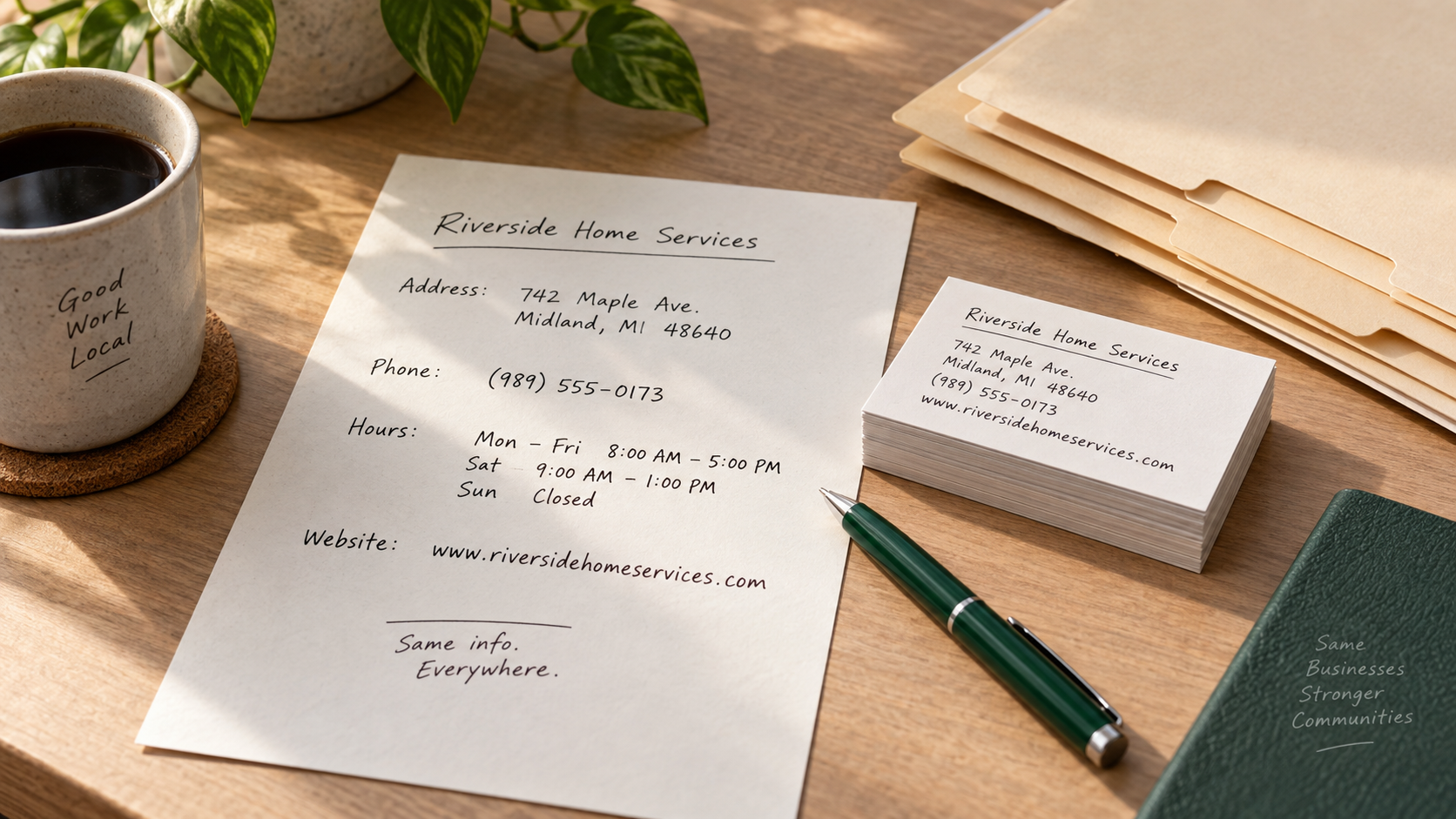
- Diff your core six profiles (GBP, Yelp, Apple Business, Bing Places, BBB if used, Facebook) against a single source-of-truth sheet for NAP, hours, categories, and URL.
- Re-run the ten buyer questions × three runs × each engine you care about; archive the cited-domain counts with the date.
- Claim or correct any new domain that entered the top tier for your trade; drop work on domains that vanished from the log for two quarters.
- Confirm OAI-SearchBot (and other search crawlers you rely on) are allowed if you want your site eligible in ChatGPT search results — that is crawl access, not a directory.
- Review measurement (tracking AI traffic in GA4 and Search Console): Search Console generative-AI impressions, GA4's AI Assistant channel, and Business Profile actions. Spot checks are not a measurement system.
- Schedule the next pass. Source mixes in these 2026 studies rewrote themselves inside six weeks without press releases.
For the wider practice of making a local business readable to assistants without chasing gimmicks, see AI SEO for small business.